The Agentic Map: Navigating the Top 20 AI Repositories
The Agentic Map: Your Guide to the 20 Repositories That Actually Matter
Something clicked for me recently.
After months of building AI systems that coordinate multiple agents, I realized we're standing at a genuinely exciting frontier.
Not the hype-cycle kind of exciting. The kind where you can build software that works while you sleep.
The kind where your code becomes a collaborator.
The kind where the gap between "what I can imagine" and "what I can ship" shrinks dramatically.
But here's the catch.
There are over 4.3 million AI-related repositories on GitHub right now. That number comes from recent ecosystem analysis, and it keeps growing.
Every week, a new framework promises to be the one you should learn.
Every week, you wonder if you're falling behind.
The opportunity is real. The confusion is also real.
What you need isn't another tutorial. You need a map.
The Agentic Stack Problem
I'm going to give this confusion a name: The Agentic Stack Problem.
It's the gap between knowing that AI agents are powerful and understanding which tools actually fit together.
Most developers I talk to have run a demo or two. Maybe you've gotten LangChain to answer questions from a PDF. Maybe you've watched an AutoGen conversation unfold between two agents.
Cool, right? But then you try to build something real—something that modifies files, calls APIs, recovers from errors—and everything falls apart.
The demo worked. Production didn't.
This isn't your fault. The ecosystem evolved faster than anyone could map it. What looked like a single category ("AI agents") turned out to be at least three distinct layers, each solving different problems.
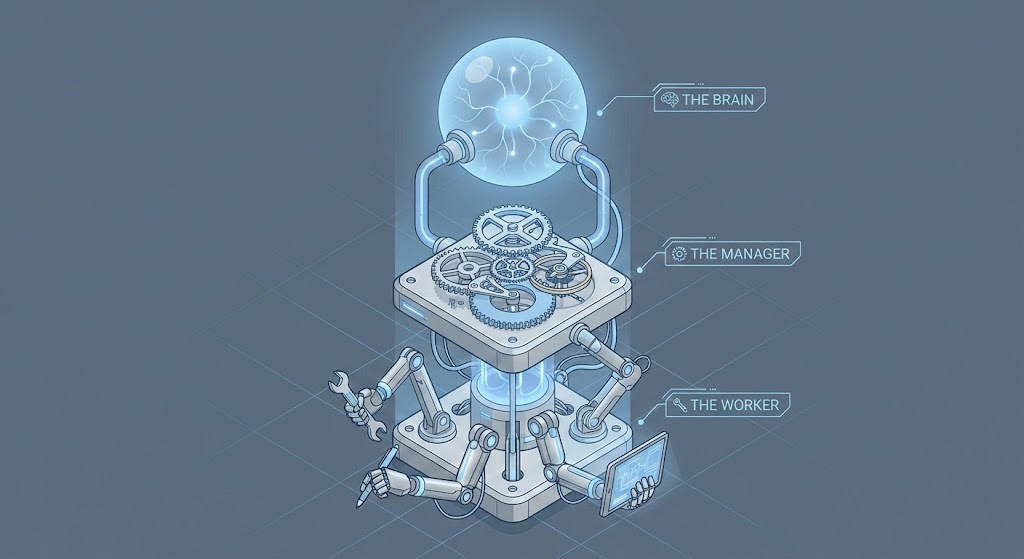
Here's the insight that changed how I think about this: The brain, the manager, and the worker are now separate.
Your LLM (the brain) is just the cognitive engine. It doesn't know how to coordinate multiple steps, manage state, or recover from failure.
That's the orchestrator's job (the manager). Frameworks like LangGraph, CrewAI, and AutoGen handle planning, memory, and multi-step workflows.
And the workers? Those are specialized agents like OpenHands and Dify—the ones that actually do things: write code, browse the web, execute commands.
When you understand this separation, the landscape suddenly makes sense.
Visualizing the separation of Brain, Manager, and Worker layers.
The 3-Layer Agentic Stack
Let me give you the map I wish I'd had six months ago.
"The map is not the territory, but a good map can save you from walking in circles."
— paraphrased from Alfred Korzybski
This framework comes from watching what actually ships to production versus what stays in demo-land. The research backs it up—academic papers from late 2025 describe a similar layered architecture for trustworthy agent systems.
Layer 1: The Primitives (Building Blocks)
These are your data connectors, your structured outputs, your retrieval systems. They handle how agents think and remember.
LangChain & LangGraph — 117k+ stars combined. LangChain is the ecosystem; LangGraph is the serious orchestration layer within it. If you need graph-based state management with checkpointing, this is where you start. The learning curve is real, but the control is worth it for production systems.
LlamaIndex — 41k+ stars. This is your RAG engine. If your agent needs to work with documents, structured data, or external knowledge bases, LlamaIndex has 160+ connectors ready to go.
PydanticAI — 8k+ stars and growing fast. Type-safe agent outputs. If you've ever been burned by an agent returning malformed JSON that crashed your downstream code, this fixes that.
Semantic Kernel — 24k+ stars. Microsoft's SDK for enterprises. If you're in a .NET/Java shop or need deep Azure integration, this is your path.
Haystack — Deepset's modular NLP framework. Production-ready search pipelines and document processing. Less flashy, more reliable.
Layer 2: The Orchestrators (Managers)
This is where things get interesting. These frameworks decide how agents work together.
AutoGen (AG2) — 43k+ stars. Microsoft Research's multi-agent conversation framework. It introduced the idea of "conversable agents" that solve problems by talking to each other. Strong for research and complex problem-solving, especially with its containerized code execution.
CrewAI — 30k+ stars. Role-playing agent orchestration. You define agents by their roles (Researcher, Writer, Critic), and CrewAI handles the delegation. Nearly 1 million downloads per month. Quick to get started, though some developers report it can feel opaque when debugging.
Agno — 29k+ stars. The performance specialist. Claims 529x faster agent instantiation than LangGraph based on their benchmarks. If you're building high-concurrency systems, worth evaluating.
OpenAI Agents SDK & Swarm — OpenAI's own frameworks. Swarm is educational and lightweight—great for learning multi-agent patterns. The Agents SDK (9k+ stars) is more production-oriented with tracing and guardrails.
Google ADK — 7.5k+ stars. Google's modular framework for Gemini and Vertex AI. Model-agnostic despite the branding, with support for hierarchical agent compositions.
Here's the real insight: orchestration is becoming the bottleneck skill. Anyone can call an LLM API. Designing systems where multiple agents coordinate, recover from failure, and maintain state across sessions? That's the new craft.
Layer 3: The Autonomous Workers (Hands)
These are the agents that actually do work—the ones that touch files, run terminals, browse the web.
OpenHands (formerly OpenDevin) — 64k+ stars. This is the leading open-source autonomous coding agent. It writes code, runs it in a sandbox, debugs failures, and commits to git. The research shows it performs well on SWE-bench, a standard benchmark for code generation.
MetaGPT — 59k+ stars. A virtual software company in a box. It assigns roles—Product Manager, Architect, Engineer—and coordinates them to generate entire codebases from natural language descriptions.
Dify — 116k+ stars. The low-code backend-as-a-service. If you want to deploy ChatGPT-like services with RAG and agent workflows without writing infrastructure code, Dify is remarkably accessible.
GPT Pilot & ChatDev — Autonomous pair programmers and team simulators. GPT Pilot drives development interactively; ChatDev gamifies multi-agent collaboration.
Cline (formerly Claude Dev) — Lives in your VS Code editor. Handles multi-file refactoring with agency—it can plan changes, execute terminal commands, create new files.
Layer 4: Infrastructure & Specialized Tools
LiteLLM — Universal model router. Stop rewriting code every time you switch from OpenAI to Anthropic to a local model.
Letta (MemGPT) — OS-like memory management for agents. If you need infinite context windows through smart memory hierarchy, this is the approach.
browser-use — 71k+ stars. Makes websites accessible to AI agents. Integrates with Playwright for browser automation.
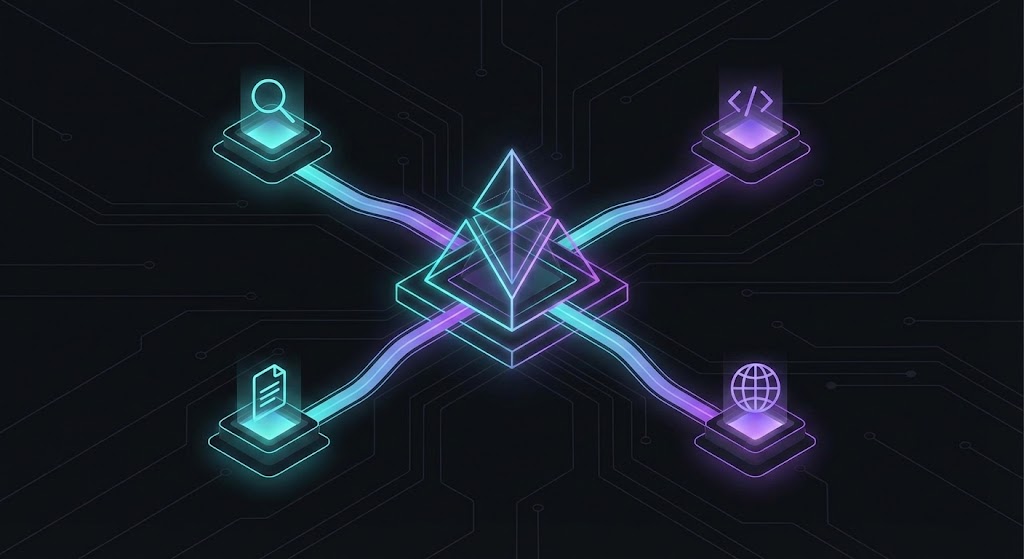
Illustrating multi-agent orchestration and coordination.n8n — 160k+ stars. Workflow automation that's become AI-native. Connect agents to Slack, Jira, Salesforce, and thousands of other tools.
The 20 Repos by Layer
Here's the tight reference you can screenshot:
Layer
Repository
Stars
Use When
Primitives
LangChain
117k+
Building any LLM app with integrations
Primitives
LangGraph
19k+
Stateful workflows with graph control
Primitives
LlamaIndex
41k+
RAG and document-heavy applications
Primitives
PydanticAI
8k+
Type-safe outputs, production reliability
Primitives
Semantic Kernel
24k+
.NET/Java shops, Azure integration
Orchestrators
AutoGen
43k+
Multi-agent conversation, research
Orchestrators
CrewAI
30k+
Role-based delegation, quick prototypes
Orchestrators
Agno
29k+
High-concurrency, performance-critical
Orchestrators
OpenAI Agents SDK
9k+
OpenAI ecosystem, production guardrails
Orchestrators
Google ADK
7k+
Gemini/Vertex AI deployments
Workers
OpenHands
64k+
Autonomous coding, SWE tasks
Workers
MetaGPT
59k+
Full software team simulation
Workers
Dify
116k+
Low-code agent deployment
Workers
GPT Pilot
30k+
Interactive pair programming
Workers
Cline
15k+
In-editor autonomous refactoring
Infrastructure
browser-use
71k+
Web browsing for agents
Infrastructure
n8n
160k+
Workflow automation with AI
Infrastructure
LiteLLM
20k+
Model routing, provider abstraction
Infrastructure
Letta
16k+
Long-term memory management
Infrastructure
Langflow
132k+
Visual workflow building
The Protocol: Building Your First Real Agentic System
1. Start With the Three Questions Filter
Before you pick any framework, answer these honestly:
Control vs. Speed? Do you need fine-grained control over every agent decision (choose LangGraph), or do you want quick role-based delegation (choose CrewAI)?
Single-agent vs. Multi-agent? If your problem is "one smart agent doing one thing well," PydanticAI or OpenHands might be enough. If you need agents collaborating, orchestrators become essential.
Sandbox vs. API tools? Does your agent need to run code and modify files (OpenHands, AutoGen with Docker)? Or does it just call external APIs (lighter frameworks work)?
Your answers determine your stack. Not the hype cycle.
2. Accept That Memory Will Break Your Agent Before Tools Do
Every developer I know underestimates memory management.
Here's what happens: your agent runs great for the first few turns. Then the context window fills up. The model starts hallucinating. It forgets earlier instructions. It loops.
OpenHands has a default max_iterations of 500 according to their CLI docs. There's a reason for that cap.
Context window overflow is the silent killer. One user in a public GitHub thread reported an agent looping for 11 days and racking up $47,000 in API costs because no one set a stop condition. That's an extreme case, but smaller versions happen constantly.
The fix: use context condensation (keep workspace persistent, summarize the chat), implement hard iteration limits, and consider specialized memory like Letta for long-running sessions.
3. Understand the Protocol Wars
Right now, agents from different frameworks struggle to talk to each other. Three competing protocols are emerging:
MCP (Model Context Protocol) — Anthropic's standard for connecting agents to external tools. Think of it as "USB-C for AI." Tool-centric.
A2A (Agent-to-Agent Protocol) — Google's standard for agent discovery and task handoff. Agent-centric.
ACP (Agent Collaboration Protocol) — IBM's enterprise-focused standard for cross-framework collaboration.
None of these are universally adopted yet. As of January 2026, most cross-framework integration still requires custom glue code. But if you want to future-proof your architecture, watch MCP—it has the most momentum in open-source communities.
4. Learn to Debug Agent Loops
The most common failure mode across all frameworks: infinite loops.
Aider users have reported agents looping on lint fixes until stopped manually. OpenHands had a documented bug where agents repeated the same action until timeout. CrewAI users describe agents calling tools repeatedly for ten minutes.
You need monitoring. AgentOps is one SDK that integrates with CrewAI, LangGraph, and others to track every tool call. LangSmith provides execution traces for the LangChain ecosystem.
The pattern: set iteration limits, add cost budgets, implement dead-loop detection. Production agents need watchers.
5. Use Small Models for Loops, Big Models for Synthesis
Running a 50-step agent loop on GPT-4 is expensive. Running it on GPT-4o is still expensive.
The smart pattern emerging in production: route simple reasoning to smaller, cheaper models (Llama 3.2 3B, Phi-4 14B), and reserve frontier models for final synthesis or complex decisions.
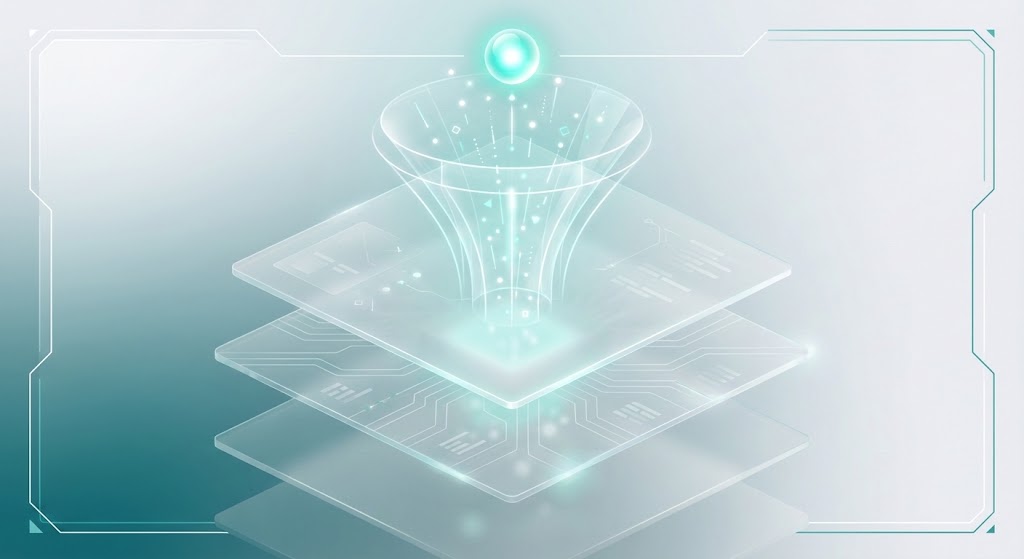
Visualizing memory hierarchy and context window management.
Phi-4 at 14B parameters often outperforms larger Llama models on math and logic benchmarks according to Microsoft's research. Qwen 2.5 Coder has become a default for open-source coding agents.
One architecture I've seen work: a tiny classifier routes tasks to cheap or expensive models. A verifier agent on a small model checks outputs. This can reduce costs by 10-100x while maintaining reliability.
6. Pick One Stack and Go Deep
If you're starting fresh in 2026, here's the golden path I'd recommend based on the research:
LangGraph for orchestration control + CrewAI for team-based delegation + OpenHands for autonomous code execution.
LangGraph gives you the state management and debugging capabilities production systems need. CrewAI's role-playing model makes multi-agent collaboration intuitive. OpenHands handles the heavy lifting of actual code generation and execution.
You don't need to learn all 20 repos. You need to understand the layer each one serves and pick the best tool for your specific problem.
7. Build Something That Saves You Five Hours a Week
Here's the mindset shift.
Stop evaluating frameworks in isolation. Start evaluating them against a real problem in your life.
What task do you repeat every week that follows a pattern? Research synthesis? Code review? Data processing? Report generation?
Pick one. Build an agent to handle it. Break things. Fix them.
That's how you actually learn this stack—not by running more demos.
The 3 Questions Filter (Quick Reference)
When evaluating any new agent framework:
What layer does it serve? Primitive, Orchestrator, Worker, or Infrastructure?
What's the failure mode? Every framework has one. Find it before you're in production.
Does it solve a problem I actually have? If not, skip it. The ecosystem will still be here when you need it.
Who You're Becoming
If you've read this far, you're not just a developer who "knows about AI."
You're becoming someone who understands agentic architecture.
You know the difference between a brain, a manager, and a worker. You can look at a new framework and immediately place it in the stack. You understand why memory and orchestration matter more than the underlying model.
That's not common knowledge. Not yet.
The developers who master this layer—the ones who can architect systems of autonomous agents, debug their failure modes, and ship them to production—will be the ones everyone calls when the real agentic work begins.
The map is in your hands now.
Build something.
—Ulver
Further Reading
If you want to go deeper on specific topics:
LangGraph Documentation — The most thorough guide to graph-based agent orchestration. Start with their "Human-in-the-Loop" patterns. https://langchain-ai.github.io/langgraph/
Letta (MemGPT) Paper — "Stateful Agents: The Missing Link in LLM Intelligence." The best deep dive on why memory architecture matters. https://arxiv.org/abs/2310.08560